AI Engineering Roadmap for Beginners: 7 Steps to Master Artificial Intelligence in 2025
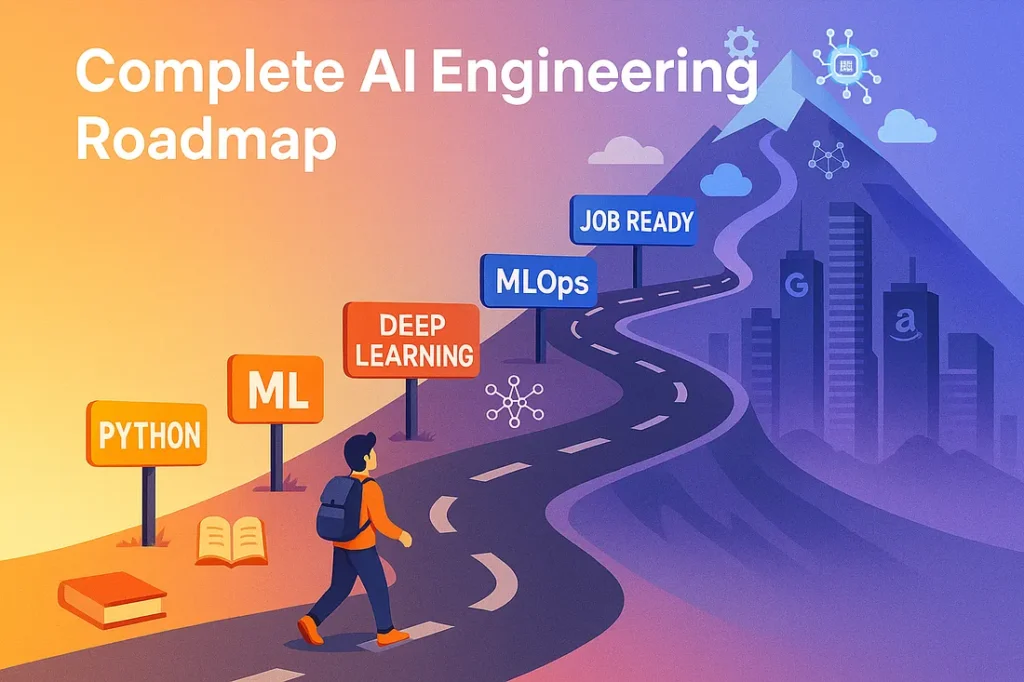
Artificial Intelligence isn’t just the future — it’s right now. From self-driving cars to smart assistants like ChatGPT, AI is shaping every part of our lives.
But here’s the real question: How do you become part of it?
If you’ve ever wondered how to enter the world of AI but felt overwhelmed by jargon and advanced math, this AI Engineering Roadmap for Beginners is exactly what you need. It breaks the path into clear, achievable steps — no PhD required.
Let’s dive in.
Why You Should Learn AI Engineering
AI engineers are among the most in-demand professionals of the decade. Whether you want to build intelligent apps, automate tasks, or launch an AI startup, understanding how AI works opens endless opportunities.
Unlike traditional software engineering, AI engineering blends coding with critical thinking, creativity, and data-driven decision-making. It’s not just about writing algorithms — it’s about teaching machines to think.
Knowing where to start makes all the difference.
Step 1: Master the Fundamentals of Programming
Every great AI engineer starts with a strong coding foundation.
Start by learning Python, the most widely used language in AI. It’s simple, powerful, and supported by countless AI libraries.
Recommended tools and libraries:
- NumPy and Pandas for data analysis
- Matplotlib and Seaborn for visualization
- Scikit-learn for machine learning models
👉 Tip: Practice on platforms like Kaggle or LeetCode to sharpen your problem-solving skills.
Step 2: Understand the Math Behind AI
Yes, math is part of the roadmap — but don’t worry, you don’t need to be a mathematician.
Focus on these essentials:
- Linear Algebra (vectors, matrices)
- Calculus (gradients, optimization)
- Statistics and Probability (data interpretation)
These concepts power algorithms like neural networks and decision trees. Learning them will help you understand why AI works — not just how.
Step 3: Learn the Foundations of Machine Learning
This is where your journey gets exciting.
Machine learning (ML) teaches computers to make predictions or decisions without explicit programming.
Start with key ML concepts:
- Supervised vs. Unsupervised Learning
- Regression and Classification
- Decision Trees, SVM, and k-Means
- Model Evaluation (accuracy, recall, precision)
Explore free resources like Google’s Machine Learning Crash Course to get hands-on experience.
Step 4: Explore Deep Learning and Neural Networks
Once you grasp ML basics, it’s time to level up.
Deep learning enables modern breakthroughs in computer vision, natural language processing, and speech recognition.
Study frameworks like:
- TensorFlow
- PyTorch
- Keras
Try simple projects — image recognition, text classification, or chatbot creation — to see deep learning in action.
Step 5: Work on Real-World AI Projects
The best way to learn AI is by building.
Here are a few beginner-friendly project ideas:
- Sentiment analysis on tweets
- AI image classifier using CNNs
- Chatbot powered by GPT models
- Fraud detection using decision trees
Building projects helps you bridge the gap between theory and application — and strengthens your portfolio for job opportunities.
Step 6: Learn MLOps and AI Deployment
Many beginners stop after building models — but real AI engineers know how to deploy them.
MLOps (Machine Learning Operations) focuses on automating, monitoring, and scaling AI systems.
Learn to use:
- Docker and Kubernetes for deployment
- FastAPI or Flask for serving models
- AWS, Google Cloud AI, or Azure ML for production environments
Understanding deployment makes your AI skills industry-ready.
Step 7: Stay Updated and Join AI Communities
AI evolves faster than any other tech field.
Follow AI thought leaders, read blogs like Towards Data Science, and join forums like Reddit r/MachineLearning or AI Discord servers.
Collaborating with others helps you stay motivated, find mentorship, and discover real-world problems to solve.
Traditional Software Engineering vs. AI Engineering
Traditional software engineers design deterministic systems — every outcome follows a fixed rule.
AI engineers, however, design learning systems that improve over time. Instead of hardcoding every condition, they feed the machine data and let it evolve.
That’s the beauty of the AI Engineering Roadmap for Beginners — it’s not about memorization, but exploration and continuous learning.
Final Thoughts
Artificial Intelligence is the defining skill of the 21st century. But the journey doesn’t have to be intimidating — it’s just about taking one smart step at a time.
This AI Engineering Roadmap for Beginners is your map, but the adventure is yours to take.
So, what’s stopping you from building the next breakthrough AI system?