The Faustian Bargain of AI: Are We Trading Our Humanity for Convenience?
Imagine being offered unlimited intelligence, instant productivity, and effortless creativity — all at the cost of your originality and privacy.
That’s the modern dilemma we face every time we click “generate” in ChatGPT or DALL·E.
Welcome to The Faustian bargain of AI, where we exchange human intuition and imperfection for machine precision and speed. It’s powerful, seductive, and—perhaps—dangerous.
Let’s unpack this modern trade-off and what it means for our work, identity, and future.
What Is The Faustian Bargain of AI?
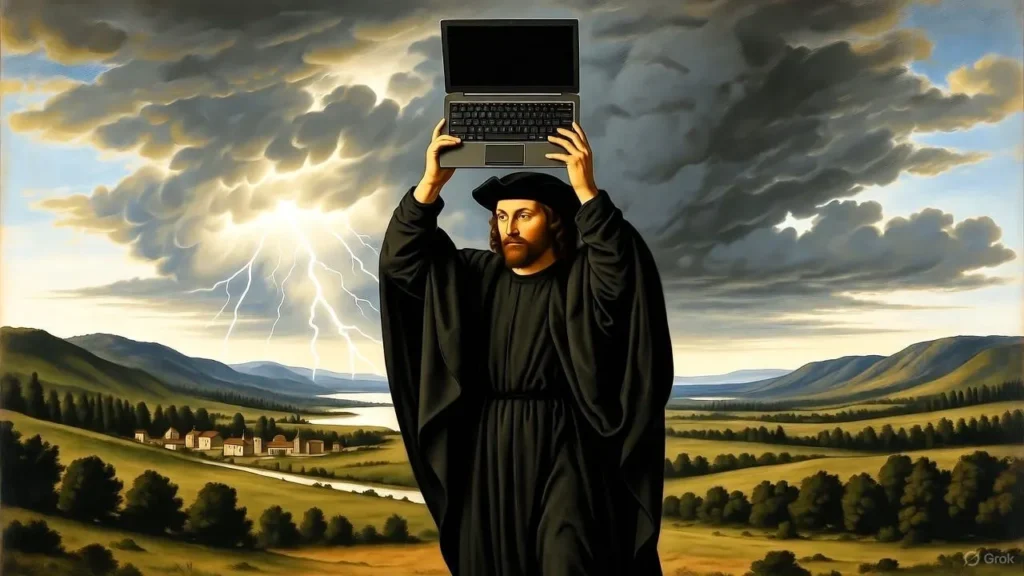
The term “Faustian bargain” comes from the legend of Faust, a man who sold his soul to the devil for unlimited knowledge and power. In today’s world, AI is our Mephistopheles — offering instant solutions, creativity on demand, and productivity without pause.
But here’s the catch: every technological leap has a hidden price.
The bargain isn’t evil—it’s seductive. We get smarter outputs, faster workflows, and digital perfection, but we risk losing human originality, privacy, and control.
That’s the essence of The Faustian bargain of AI — a deal that seems irresistible until we question what we’re giving up.
The Sweet Side of the Deal: Benefits of AI
Let’s be honest: AI is transforming our lives in ways we once dreamed about.
- Productivity Revolution: Tasks that took hours — writing, coding, designing — now take minutes.
- Democratized Creativity: Tools like Midjourney and Runway ML let anyone become an artist or filmmaker.
- Smarter Decisions: AI models analyze data patterns faster than any human analyst could.
- Accessibility: From real-time translation to assistive tools for disabilities, AI makes life easier and more inclusive.
In short, we’ve gained superhuman capabilities, and that’s hard to resist.
But every superpower comes with a shadow.
The Dark Side: The Price We Pay
Every bargain has its cost. With AI, the payment isn’t money — it’s control, authenticity, and privacy.
1. Loss of Creativity
When we rely too much on AI to write, draw, or think, we risk losing the messy, imperfect spark that makes human art meaningful. Creativity thrives on friction — something AI smooths away.
2. Data as Currency
AI learns from our digital footprints. Each prompt, photo, and click feeds its brain. In return for smarter responses, we unknowingly trade our personal data.
3. Erosion of Skills
Like calculators weakened our mental math, AI could dull our critical thinking, research, and writing muscles.
4. Bias and Misinformation
Even the smartest AI systems inherit human bias from their training data — amplifying inequality, misinformation, and stereotypes.
This is The Faustian bargain of AI in full view: convenience in exchange for autonomy.
Comparing Then vs. Now: Traditional vs. AI-Driven Work
| Aspect | Traditional Approach | AI-Driven Approach |
| Creativity | Organic and emotional | Efficient but formulaic |
| Speed | Slow and methodical | Instant and automated |
| Control | Fully human | Shared with algorithms |
| Learning Curve | High effort, deep understanding | Low effort, shallow understanding |
| Outcome | Unique, imperfect, authentic | Polished, predictable, scalable |
The trade-off becomes clear: AI gives us output, but not always insight.
Real-World Examples of the Faustian Bargain
- Artists using AI tools now face blurred ownership — who created the art: the person or the algorithm?
- Writers using ChatGPT can produce at lightning speed, but many lose their authentic voice over time.
- Companies automating hiring or analysis risk embedding systemic bias — efficiency at the expense of fairness.
The temptation is strong: more output, less effort. But each click distances us slightly from our humanity.
Practical Tips: How to Use AI Without Losing Yourself
The bargain isn’t inevitable — it’s manageable. Here’s how to stay human in an AI world:
- Use AI as a Co-Pilot, Not an Autopilot
Let AI assist, not replace. Think of it as brainstorming with a tireless partner, not outsourcing your soul. - Stay Curious and Critical
Always question outputs. Ask: Why did the AI suggest this? What bias or data drove that choice? - Protect Your Data
Avoid sharing sensitive or private information in AI tools. Read privacy policies carefully. - Keep Practicing Your Craft
Write, paint, build — even if AI can do it better. Practice preserves your edge and intuition. - Balance Efficiency with Depth
Fast doesn’t always mean better. Use AI to speed up mechanics, not meaning.
The Bigger Picture: Are We Losing the Plot?
In the grand story of progress, AI is our latest magic spell — one that can heal or haunt us depending on how we wield it.
The Faustian bargain of AI isn’t about rejecting technology — it’s about remembering why we built it. AI should amplify human creativity, not replace it. It should serve people, not profit alone.
The danger isn’t that machines will outthink us — it’s that we’ll stop thinking for ourselves.
Final Thoughts
We stand at a fascinating crossroads: limitless innovation on one side, and potential self-erasure on the other.
The question is no longer “What can AI do?” but “What should we let it do — and at what cost?”
So before you click “generate” again, pause and ask yourself:
👉 What part of my soul am I trading for convenience today?