
Agentic AI: Single vs Multi-Agent Systems — The Future of Autonomous Intelligence
Imagine an AI that not only follows your commands but thinks, plans, and collaborates with other AIs to achieve complex goals — all without your constant supervision.
That’s the world of Agentic AI — a new frontier where artificial intelligence moves beyond static prompts to become self-directed, adaptive, and collaborative.
But when it comes to building these intelligent systems, there’s a key question innovators must answer: Should we use single-agent systems or multi-agent systems?
Let’s unpack what each means — and why this distinction could shape the next decade of AI development.
What Is Agentic AI?
Agentic AI refers to systems capable of autonomous reasoning, goal-setting, and decision-making. Unlike traditional AI tools that respond only when prompted, agentic systems can take initiative — analyzing tasks, executing actions, and learning from outcomes.
Think of ChatGPT, but one that can decide to search the web, summarize data, write code, and email you the results — all without being told step-by-step.
These agentic systems can be either single-agent (one AI managing all tasks) or multi-agent (multiple AIs working together like a digital team).
Single-Agent Systems — The Solo Thinkers
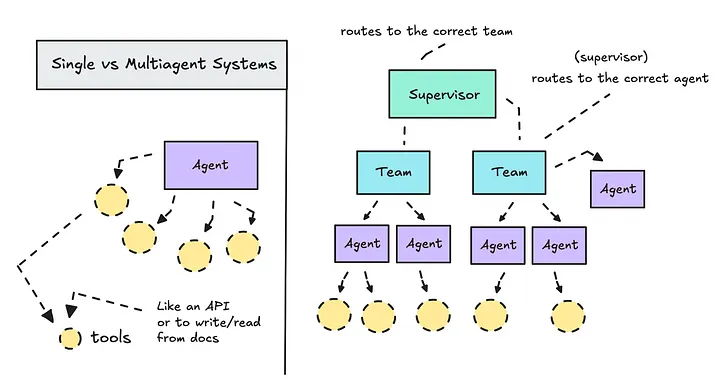
A single-agent system is like having a super-intelligent personal assistant. It acts as one cohesive brain that plans and executes tasks independently.
How Single-Agent AI Works
A single-agent AI has access to various tools and data sources but operates under one unified decision model. It can perform research, analyze data, or automate workflows — all while maintaining context and continuity.
Examples of Single-Agent Systems
- AutoGPT and BabyAGI — autonomous task-running AIs that loop through planning and execution.
- Personalized AI Assistants — future versions of Siri, Alexa, or ChatGPT that manage your schedule, projects, and messages automatically.
Benefits
✅ Consistent decision-making
✅ Easier to monitor and control
✅ Lower system complexity
✅ Ideal for personal or small-scale use
However, a single-agent setup can struggle when faced with highly complex or interdisciplinary tasks, where collaboration or parallel execution would be more efficient.
Multi-Agent Systems — The AI Team Players
In contrast, multi-agent systems (MAS) involve multiple autonomous agents that communicate, negotiate, and cooperate to achieve a shared objective.
Think of it as a digital company: one AI writes code, another tests it, another documents it, and another deploys it — all in real-time collaboration.
How Multi-Agent AI Works
Each agent in the system has a specialized role — research, planning, design, or execution. They exchange information, assign sub-tasks, and optimize collective performance through feedback loops.
Examples of Multi-Agent AI in Action
- ChatDev — an AI software company simulation where agents act as CEO, CTO, and developers to build products autonomously.
- CrewAI and MetaGPT — frameworks that allow teams of AIs to collaborate on problem-solving, product development, and research.
- Swarm Robotics — robots coordinating autonomously to perform logistics, search-and-rescue, or exploration missions.
Benefits
✅ Scalable and parallel processing
✅ Diverse perspectives and expertise
✅ Improved resilience (no single point of failure)
✅ Enables dynamic collaboration at scale
But managing communication, preventing redundancy, and maintaining coherence between agents can be challenging — a problem researchers call the coordination dilemma.
Agentic AI vs Traditional Automation
| Feature | Traditional Automation | Agentic AI |
| Initiative | Executes fixed rules | Acts autonomously |
| Adaptability | Low | High |
| Collaboration | None | Multi-agent teamwork |
| Learning | Static | Continuous |
| Applications | Repetitive tasks | Complex, evolving goals |
Traditional automation works best for repetitive tasks. Agentic AI, on the other hand, thinks strategically, learning and adapting like a human — but faster, and at scale.
Practical Use Cases of Agentic AI
1. Business Automation
Multi-agent AI systems can act as a full operations team — managing customer service, data analysis, and content creation simultaneously.
2. Software Development
Platforms like CrewAI can automate entire development pipelines — from design to QA — using specialized agents.
3. Research and Innovation
AI scientists collaborate autonomously to propose hypotheses, run simulations, and summarize findings faster than human teams.
4. Smart Cities
Agentic AI can manage energy grids, traffic systems, and emergency responses — each handled by separate but communicating agents.
5. Personalized Education
Single-agent tutors can adapt lessons in real-time, while multi-agent systems can coordinate subject matter experts to create dynamic learning paths.
Tips for Choosing Between Single and Multi-Agent AI
- Start Small: Begin with a single-agent system to automate personal workflows.
- Scale Gradually: Transition to multi-agent setups for team or enterprise-level automation.
- Define Roles Clearly: Each AI agent should have a specific, measurable objective.
- Monitor Coordination: Use feedback and logging systems to prevent conflicting actions.
- Prioritize Security: As agents gain autonomy, ensure strict access and data permissions.
The Future: When AIs Collaborate Like Humans
The rise of Agentic AI: Single vs Multi-Agent Systems marks a turning point in automation — from static intelligence to dynamic ecosystems of autonomous digital minds.
In the next few years, we may not just use AI — we’ll collaborate with it. Teams of AIs could manage companies, design products, or even govern digital societies.
The only question is:
When every AI becomes an agent — who will lead the team?